

Learning how to understand modes on guitar is something that I would argue every player should invest some time on. Modes are a sure-fire way to discover the relationship between different scale shapes and tonal centres. They also help to open up the fretboard in a very useful and practical way. Don’t get me wrong, I love a good pentatonic or blues scale, but I couldn’t bear to be stuck using the same box scale shapes over and over again. Modes are a great way to break out of this.
I’ve taught the theory behind modes and how to use them to many students over the years. It’s a subject that I really enjoy both as a player and a teacher. There is a lot of depth to it and it’s something I utilise in my playing almost daily.
I often get surprised, though, by the amount of apprehension and reluctance there seems to be towards the subject. It’s something I’ve noticed with my students, but I also see a lot of mystery and confusion surrounding it online. Often this tends to be more the case with less experienced players, but it concerns me the number of posts and threads I see on forums, sub-Reddits, and Facebook groups where modes are hotly debated and argued about.
It seems that there is a lot of partial and incomplete understanding out there on how modes work, and I wonder if this is perhaps due to the sheer number of resources available; all of which are in competition for our attention. Couple that with the fact there are no quality controls for the accuracy and reliability of what people post on their own websites. Then there is bound to be a spread of miscommunication and misunderstanding as a result.
Now the irony of saying that whilst arguably doing the exact same thing is not lost on me. However, my aim with this article is not just to create an accurate and reliable resource. It’s also to put down my own thoughts and ideas on a subject I find very interesting. If what I write proves helpful to others, then that’s simply a bonus for me!
So, whilst I’ll do my absolute best to make sure everything here is factual and reliable, this will be a guide to modes based on my own practical use and understanding of them. Which, after a good many years, I’m pretty confident in. But if you do spot something amiss, feel free to give me a polite nudge on it!
Now let’s get into some theory!!
THEORY: Understanding the Basic Concept
In the most basic sense modes can be thought of as simply scales that are played in a particular order. That can be either from the root note or, instead, starting from the 2nd or 3rd note. Or any other note. You can take any scale and start it from any note, then play the rest of them in sequence. At that point, in essence, you are playing a particular mode.
An easy way to begin understanding this is to take a scale and lay out the notes in order.
Here are the notes of a C Major scale for example:
C D E F G A B C
In western music, a scale, like this C Major scale, contains seven notes and usually the octave of the first. That makes eight notes in total that we want to concern ourselves with. If you play this scale as it is (from C to C), then you have just engaged in modal playing. This is because a Major scale is in itself a particular mode. (Technically it's known as Ionian mode, but we'll get into the specific names of different modes later).
Now, if we take that same scale, or more specifically that same sequence of notes, but instead we start from the second note, D, then we would be playing another mode. The only change we would need to make is to add another D note to the end of the sequence. This would then complete the full cycle of eight notes and make an octave.
For example:
D E F G A B C D
Essentially, all we have done is start the same sequence of notes from a different place. But now we’re playing a completely different mode with a different tonality and sound characteristic.
Let's try another example. From that original C major scale, let's start the sequence from the 6th note in the scale, A:
A B C D E F G A
Now we have another completely different mode with, again, a different tonality and sound characteristic.
So, as you can see the basic concept isn’t really that complicated. Start a scale from a different note in the sequence and voilà, you have a different mode. It certainly doesn’t warrant the mystery and apprehension I described earlier. However, there is a bit more to it than that, and we’ll expand on that later. For now, though, let’s put this idea into some practical guitar-related context.
PRACTICE: Applying the Concept to the Guitar
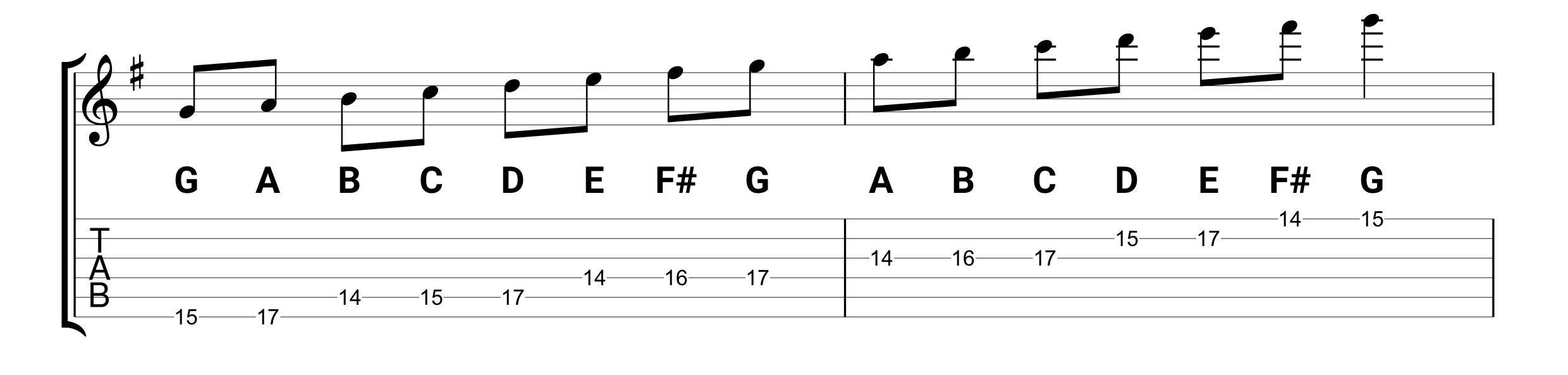
Firstly, let’s get familiar with the two-octave G Major scale below - if you aren’t already familiar with it. We’ll be using G Major for most of the practical discussion and examples throughout this post. It tends to be the most useful in terms of its position. Plus, it only has one sharp and no flattened note names, which keeps things nice and simple.
G Major Scale - Two Octave
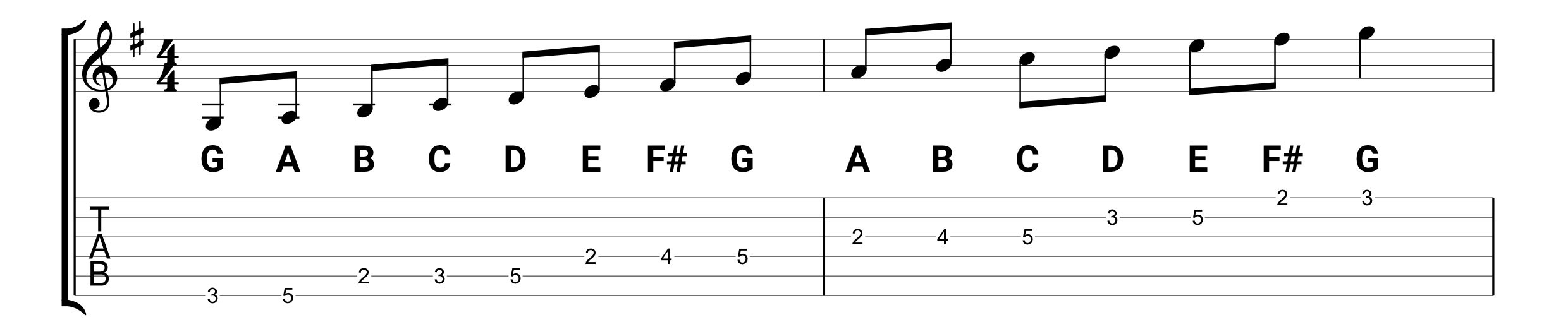
Once you’re familiar with this scale, imagine this as the framework for the next few exercises that we’ll look at. For now, we won’t move outside of this two-octave scale; no higher or no lower.
Next play just the first 8 notes or octave of that scale. This will give us the following sequence of notes:
G A B C D E F# G
This time, instead of starting on the first note, the G, start on the second note, the A. Do the same thing and play 8 notes (an octave) going from A to A. This is the same idea as what we looked at before with C Major. We’re just using a different scale. That should then give you the following sequence:
A B C D E F# G A
Now, do the same for every other note in the sequence. The next will start from B and you’ll play 8 notes from B to B. Then start from C playing 8 notes from C to C, and so on.
Here’s an example of how that should sound if you played one sequence of notes after another.
Congratulations!! You have just played through all 7 modes of the major scale. This makes you a modal master!! Well…maybe not quite yet.
As you might be thinking, this way of playing modes is a little limited. It’s not really the key to unlocking the fretboard as advertised earlier. It is useful for helping to visualise the idea of starting a scale from different notes in the sequence. But we want to have a bit more freedom in where we can move around the fretboard. So, let’s see how we can extrapolate this.
PRACTICE: Extrapolating Across the Fretboard
Take a look at the scale in the tab below. It’s a G Major scale once again, but this time it’s only one octave and runs horizontally across the 6th string.
G Major Scale - Horizontal Across 6th String
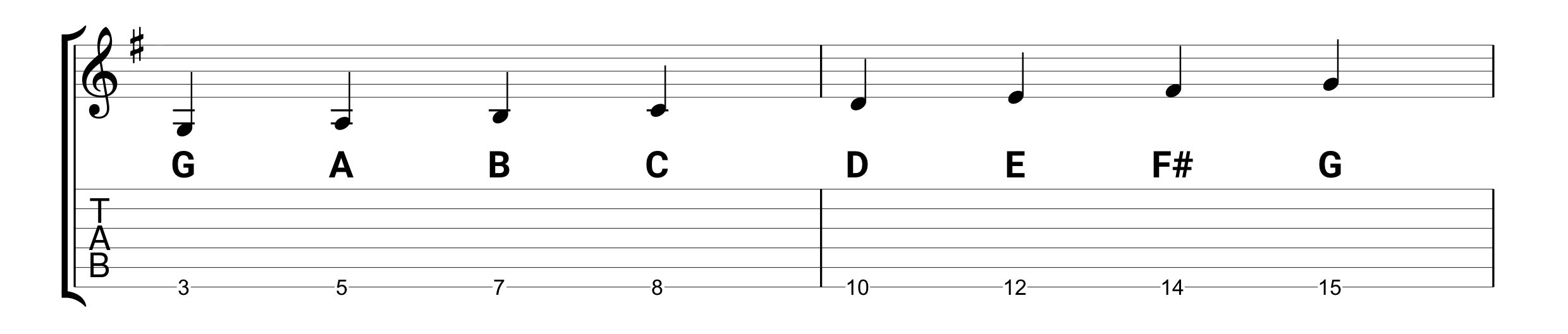
Now, this isn’t the most practical scale you might come across. It won’t hurt you to learn it. But you probably won’t find it falling out from under your fingers whilst in the thralls of an impassioned solo. However, it is very useful for us right now as it sets up another framework that we’ll use for the following exercises.
Each note in this scale represents a starting point for playing the different modes of the Major scale, similarly to the previous section. However, at each starting point, we’ll continue the sequence of notes across the strings up to two octaves. This means we’ll be playing a new scale shape starting from each of these notes on the 6th string.
The interesting thing here is that each shape won’t actually be a new scale. It will be the same sequence of notes; G, A, B, C, D, E, F#, G just in varying orders. At this point, it’s also worth introducing the names of the different modes as we’ll now have dedicated scale shapes to associate them with, which is useful in helping to memorise them.
So, let’s look at each of these scale shapes (or modes) in turn, starting with one that you already know - The Major scale also known as Ionian Mode.
Shape 1 – Ionian Mode
Starts from the 1st note of the Major scale.
Shape 2 – Dorian Mode
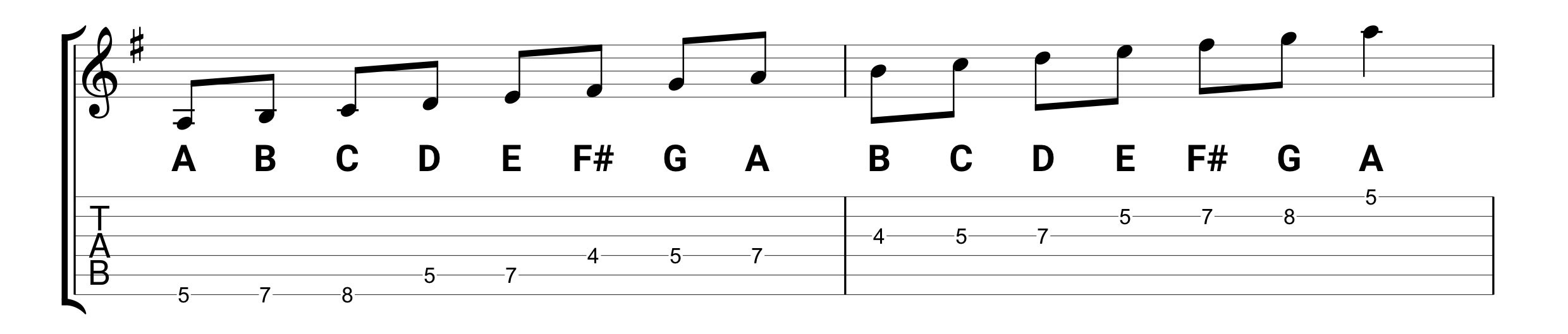
Starts from the 2nd note of the Major scale.
Shape 3 – Phrygian Mode
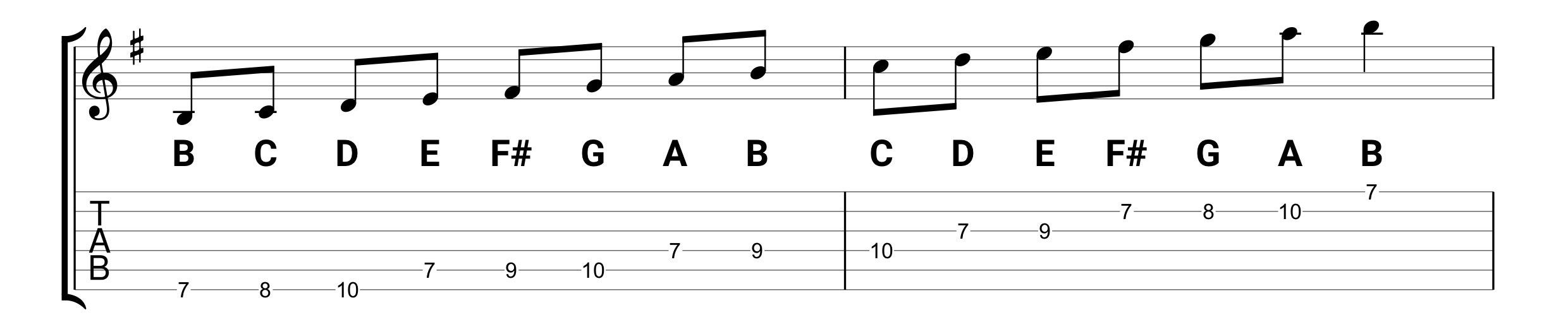
Starts from the 3rd note of the Major scale.
Shape 4 – Lydian Mode
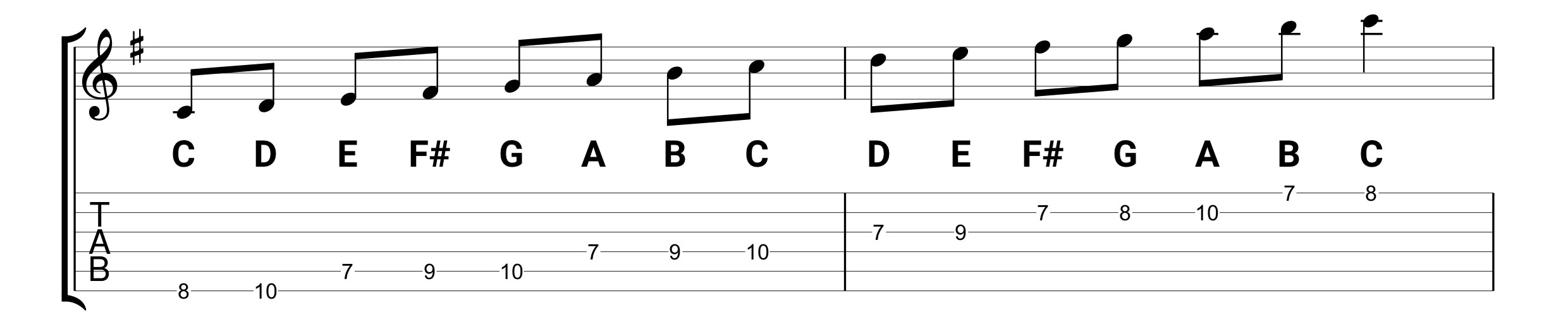
Starts from the 4th note of the Major scale.
Shape 5 – Mixolydian Mode
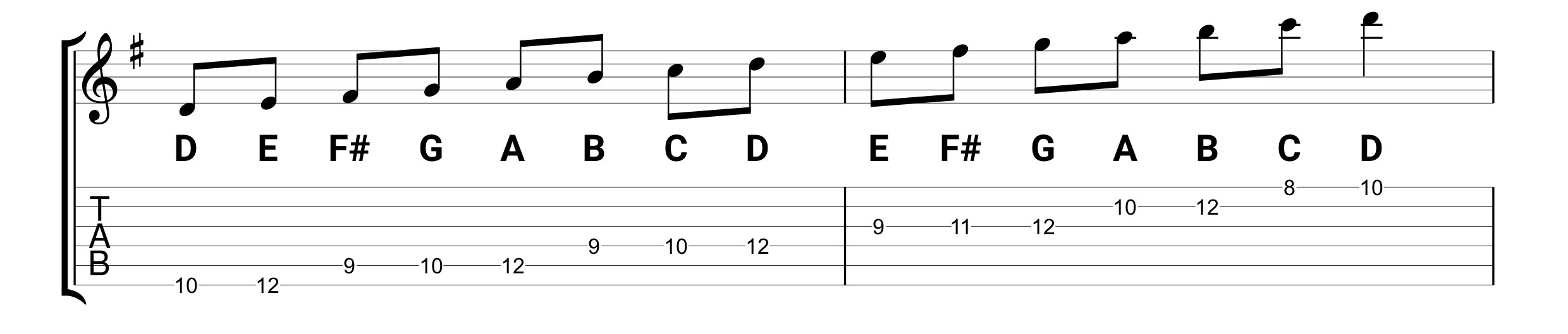
Starts from the 5th note of the Major scale.
Shape 6 – Aeolian Mode
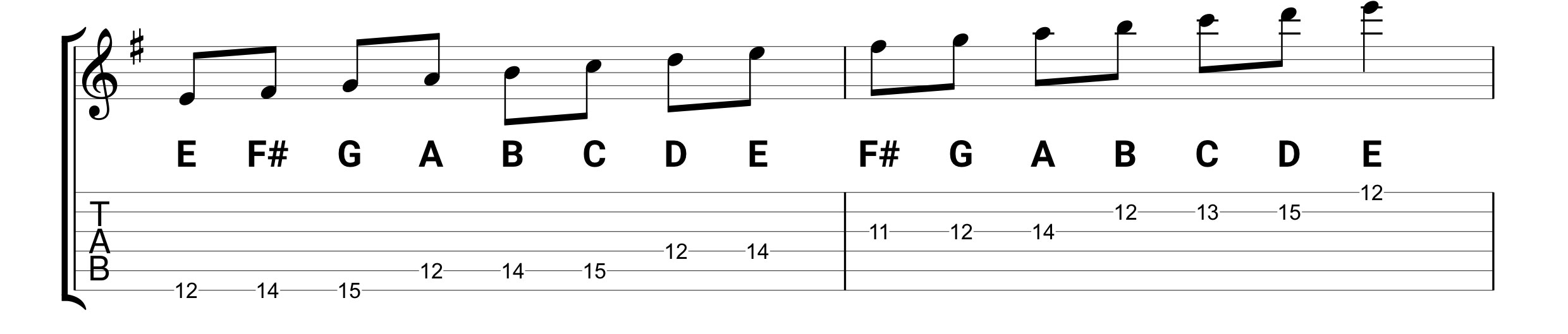
Starts from the 6th note of the Major scale.
Shape 7 – Locrian Mode
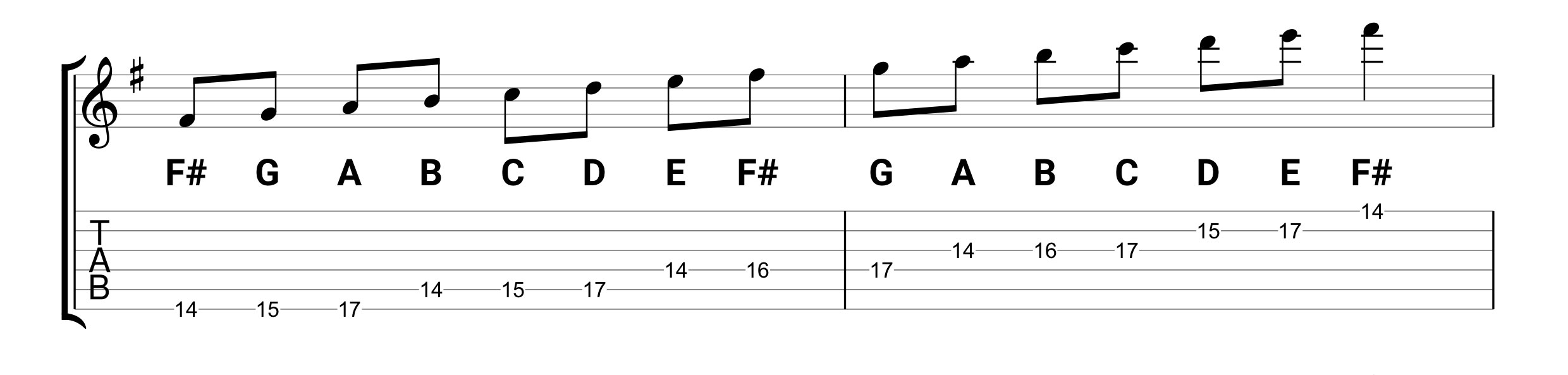
Starts from the 7th note of the Major scale.
And to complete the eight-note cycle here is shape 1 again but this time played an octave above where we’ve already played it.
Ok, so there are a fair few shapes there, which may be a lot to take in if they’re new. If this is the case, I recommend you spend a good amount of time getting familiar with them before you move on.
The main thing to keep in mind whilst practising them is fundamentally they are all the same scale – G Major. You are just starting each shape from a different note in that scale. One thing you can do to drive this idea home is say the note names as you play through them. You’ll soon realise that you only ever use the same 7 note names, just in varying orders.
So, let’s summarise what we’ve covered so far:
- A scale is a sequence of seven different notes, which usually includes the octave of the first note.
- This sequence can be played in any linear order e.g. G A B C D E F# G can also be C D E F# G A B C.
- Whichever order you play the sequence in i.e. whichever note you start from, is the order of notes for a particular mode.
- There are 7 modes that come from the standard major scale. They are Ionian, Dorian, Phrygian, Lydian, Mixolydian, Aeolian, and Locrian.
- You can play modes either within a single scale shape e.g. The two-octave G Major. Or you can spread them out across the fretboard and have individual scale shapes for each mode. They will still be the same fundamental scale though.
Now, whilst you’re taking some time to work through those shapes, I’m going to go and put the kettle on to make a cup of tea. I’ll see you in part 2 of this article where we’ll look at how we can start applying these shapes, and modes in general, to our own playing.